Practical Kung Fu : Utilizing the eyes to raise the foot in Tai Chi Chuan as well as our daily activities.
by Jim Russo
August 10th, 2023
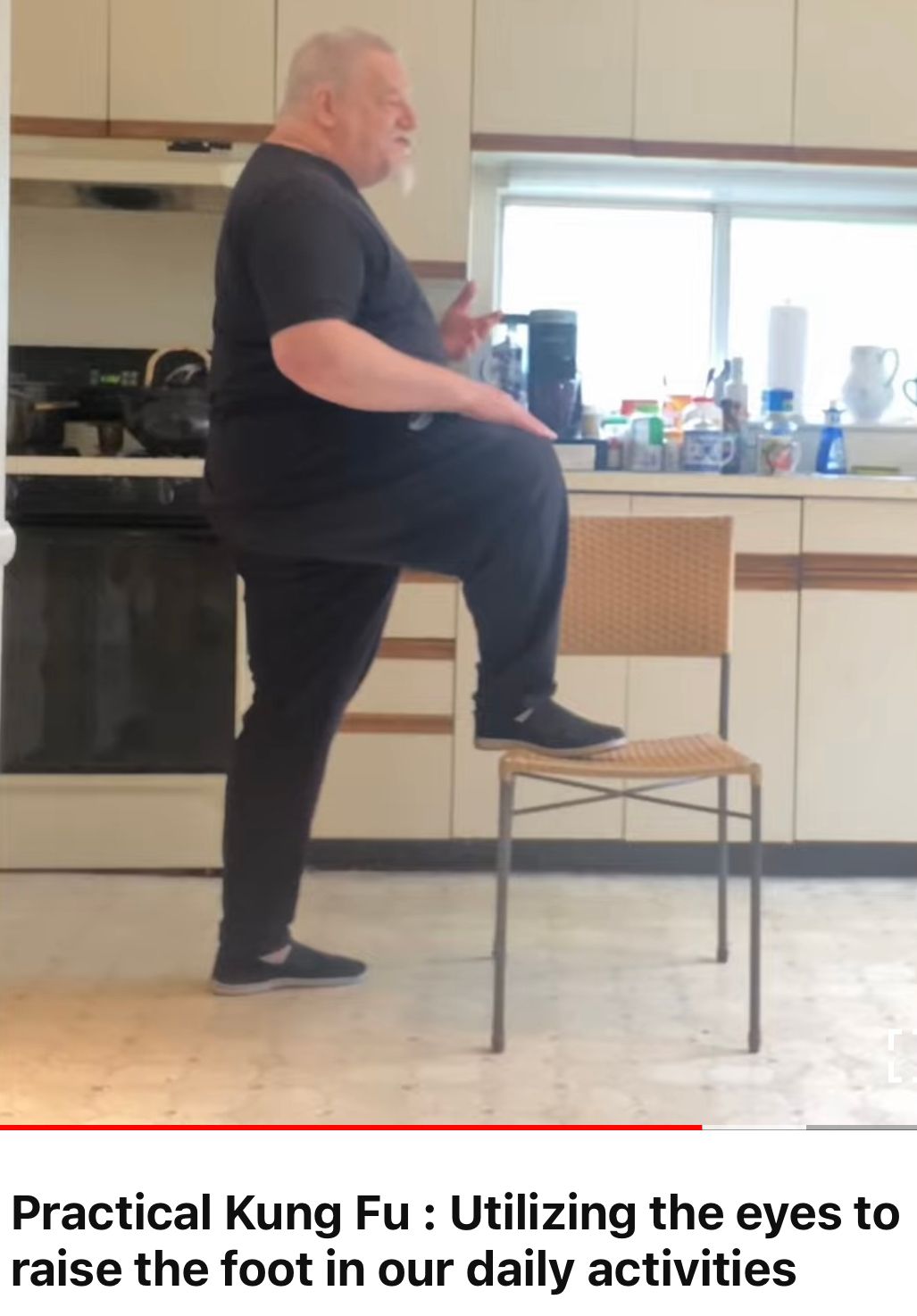
Practical Kung Fu : Utilizing the eyes to raise the foot in Tai Chi Chuan as well as our daily activities.
One of the things I like to do is to utilize the principles of the internal arts to solve problems that one may contend with
in our daily activities. One of my friends had trouble stepping onto a boat the other day, and they felt that they couldn't lift their leg high enough . These are natural occurrences as one ages . I pointed out to them what the problem was, and gave them a solution based on the internal arts principles. We are first going to talk about the use of the eyes. The eyes are a joint and if you fix your eyes on something you will tie up your spine as well as your spirit . If I look to the edge of the step when I go to lift my leg, my spine won't move nor assist in the lifting of the leg and my spirit will stay fixed as well. The end result is that I will have tied up my body and made it difficult, if not impossible to reach the step . It is necessary to look at the step, and then let the eyes look out and let the head raise up and the spirit raise and open the spine. This will let the power of the spine assist in lifting the leg. When you do this, you will find that it's effortless, and requires no internal strain to lift your leg a much higher distance comfortably and easily . The result is that our self-esteem as well as our spirit will not be crushed by the obstacle but instead we will be invigorated by our natural and effortless success . The same energetics apply to the principle of letting " the eyes guide and guard " the movement of the hands and the body in Tai Chi Chuan . This can also be applied to getting into the Posture, " Golden Rooster Stands on One Leg" from the Tai Chi Chuan form and you'll find that it is actually very easy to get into the posture when we utilize our intention and our spirit and let our eyes freely lift the spine and assist the leg. I hope this is helpful in your internal practice, as well as in your daily life.